

We have finished siman 1, and need to clarify one point. The Chayei Adam wrote that reshima is chayav. The Gemara explains that reshima refers to making a symbol as a signature instead of writing one’s name. For example, Rav would make a picture of a fish instead of signing his name. This symbol is included in the concept of reshima, and one would be chayav for making it. Specifically, making two reshimos is the shiur chiyuv mideoraysa, and making one would be chayav due to the concept of chatzi shiur. Reshima is a toldah of koseiv.
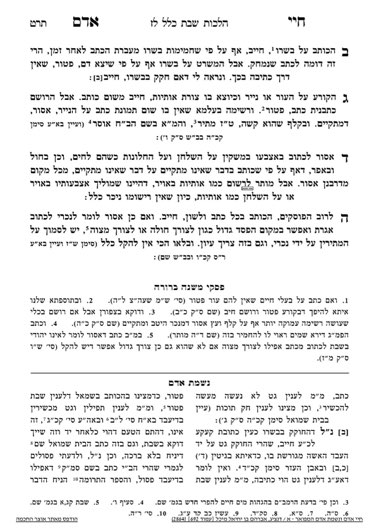
In siman 2, the Chayei Adam writes that writing on one’s skin is included in the melacha of koseiv. The Gemara asks that the nature of the body is that, due to the natural secretions of the body, the writing will eventually fade, so the writing is missing the condition of miskayeim and should not be assur. However, the Chayei Adam explains that writing on one’s skin is comparable to writing which was erased due to external factors. In other words, if a person writes something in a permanent manner, if someone or something comes along and erases it, it is not considered aino miskayeim, because the writing was inherently permanent, just an external factor came along and erased it. In a similar manner, the writing on one’s skin is also considered inherently miskayeim, and it is erased only due to the external factors of the body.
There is a question which comes up regarding contemporary various forms of electronic writing. Most electronic devices are considered aino miskayeim, because the writing requires an electric current in order to keep it going. However, there are certain types of e-readers where the writing remains, even without electric current, until the page is refreshed. These types of e-readers are considered miskayeim.
The Chayei Adam continues, and writes that one who scratches into their skin is patur. The Gemara says it is a foolish thing to do, and brings a story of a person who went to Mitzrayim to learn their forms of kishuf. Since they would search each person as they left Mitzrayim to ensure they were not carrying out any of their formulas for kishuf, this person scratched it into their skin in order to bring it out. The Gemara tries to use this story as a proof that it is normal to write on one’s skin, but ultimately rejects it and concludes that it is not normal and therefore patur. (The Gemara also suggests that the person in this story was none other than Yeishu.)
In contrast, the Chayei Adam writes that if one engraves an entire letter into their skin, they will be chayav, because it has more permanence.
Summary
- Reshima is a toldah of koseiv and refers of making symbols instead of letters.
- Writing on one’s skin is considered koseiv, as is engraving. However, scratching is not considered koseiv.
- Most electronic writing is not considered miskayeim and patur. However, certain e-readers keep the text even without electronic current, and would be considered miskayeim.