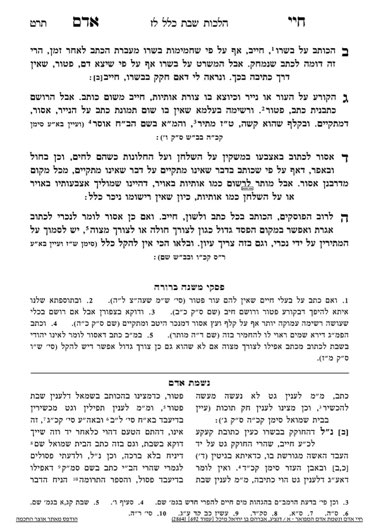
We are beginning Klal 37, which discusses the melacha of koseiv, writing. The source for this melacha is that the kerashim (the wooden beams) outside of the Mishkan would be labeled in order to identify that they were put back in the same place every time they were moved. This was done to ensure that the proximity of each beam to the kodesh hakodashim or the kodesh was not diminished. In order to keep track of each beam, they would put letters on each.That being the case, the shiur chiyuv for the melacha is two letters, because they would identify which two beams went next to each other through one letter on each beam. Additionally, we learn from the way the letters were written that the shiur can be fulfilled even when the two letters are not on the same page, as long as they can be placed next to each other.The melacha is both writing and creating a letter. Thus, taking pre-existing letters (eg, stickers, scrabble pieces) and forming them into words is not assur. There is a potential issur derabanan if one combines letters to make words in a way which has some amount of permanence, but otherwise, the melacha is primarily the actual creation of the letter. A letter can be created both through creation and erasure. For example, if one removes the middle connector in the letter ches, they have now created two zayins, so they would be chayav for koseiv. There is a condition of kiyum, permanence, to the melacha. The melacha does not need to last forever, per se. The Rashba explains that ink used for a document which a person would like should remain for a long time is considered kiyum. Therefore, the Mishnah Berurah assumes that one is chayav mideoraysa for koseiv even if they use pencil, because it can last a long time. There is a concept of chatzi shiur assur min hatorah, that even less than the minimum is chayav mideoraysa. Therefore, even one letter is assur to write on Shabbos. The only exception is if one writes the final letter to complete something (eg, a sefer being written), where the significance of finishing the item is such that one would be chayav. This applies to corrections as well. Summary
The melacha of koseiv is the issur of writing and creating letters.
The shiur deoraysa is writing two letters, even if not on the same page.
The two letters can be written both through active writing and through erasure.
The writing needs to have kiyum, some amount of permanence.
Although the shiur is two letters, chatzi shiur is assur.