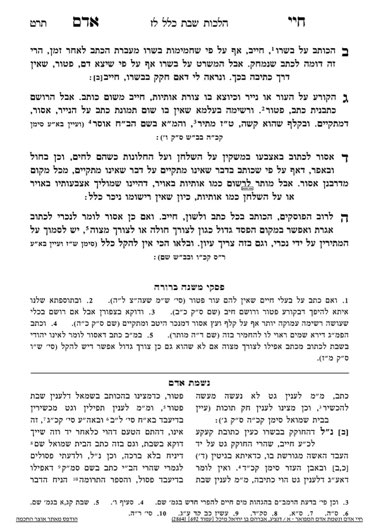


We have finished siman 3 and are discussing cutting toilet paper. We learned that, besides for the melacha of korea, the melacha of mechateich will apply if a person cuts the toilet paper to a specific size.
In the previous shiur, we learned the heter of amira l’achum to ask a non-Jew to cut the toilet paper. Although amira l’achum on an issur deoraysa is normally assur, Chazal made an exception to amira l’achum in this situation, due to the kavod habriyos at stake.
If a non-Jew is not available, Chazal permitted performing a melacha deoraysa with a shinui. Obviously, they cannot permit an issur deoraysa, but the shinui case is only assur miderabanan, so they permit that case due to the kavod habriyos involved. To clarify, the heter of kavod habriyos only applies to significant kavod habriyos issues, and the need for toilet paper after using the bathroom is assumed to be significant. Therefore, one may tear the toilet paper with a shinui. An example of a shinui would be to use one’s elbows to cut the toilet paper.
The next question is, once there is a scenario in which it is muttar for a person to cut the toilet paper themselves (with a shinui), is there a difference between cutting it on the perforations or between the perforations. Many assume that tearing on the perforations is cutting it to a specific size, which is mechateich. If so, they assume that even in scenarios where one is allowed to cut the toilet paper, one should avoid tearing it on the lines, so that they are only relying on the heter of kavod habriyos for korea and not for mechateich.
However, the argument is unnecessary. Tearing on perforations will only be a problem of mechateich when there is a benefit to that size. For example, the perforations on a tissue box allow for tissues to be removed while the box remains intact. Therefore, tearing on the perforations is chayav. However, the perforations on toilet paper are not significantly beneficial, as most people do not use only one panel of toilet paper for each use. The purpose of the perforations are purely financial, in that since people need more than one panel per use, they will use up the roll more quickly and buy more. (One of the ways we know the sizing of the perforations is not of significant benefit to the user is that the size of each toilet paper panel varies from company to company.) Therefore, it comes out that one does not need to be concerned for mechateich when cutting the toilet paper, because the perforations themselves are not significant.
In regards to the toilet paper roll itself being muktzah, the kavod habriyos aspect overrides that concern.
If one needs to open a box of tissues, they should open it in a way that it destroys the box, as the act of mekalkeil ensures there is no issue of korea. There certainly will not be an issur of mechateich.
Summary
In regards to cutting toilet paper on Shabbos, preferably, one should have a non-Jew tear it. If amira l’achum is not possible, one can tear the toilet paper with a shinui. One does not need to be careful to avoid tearing on the perforations.
In regards to opening a box of tissues, one should open the box in a way that destroys it.